
Emergency Tree Service In Snohomish
Fast Response, Safe Removal, Family Service Since 1988
Proudly serving Snohomish, Monroe, Marysville, Lake Stevens, Everett, and surrounding areas
What Snohomish Properties Face After a Windstorm
When a Tree Comes Down. We’re There.
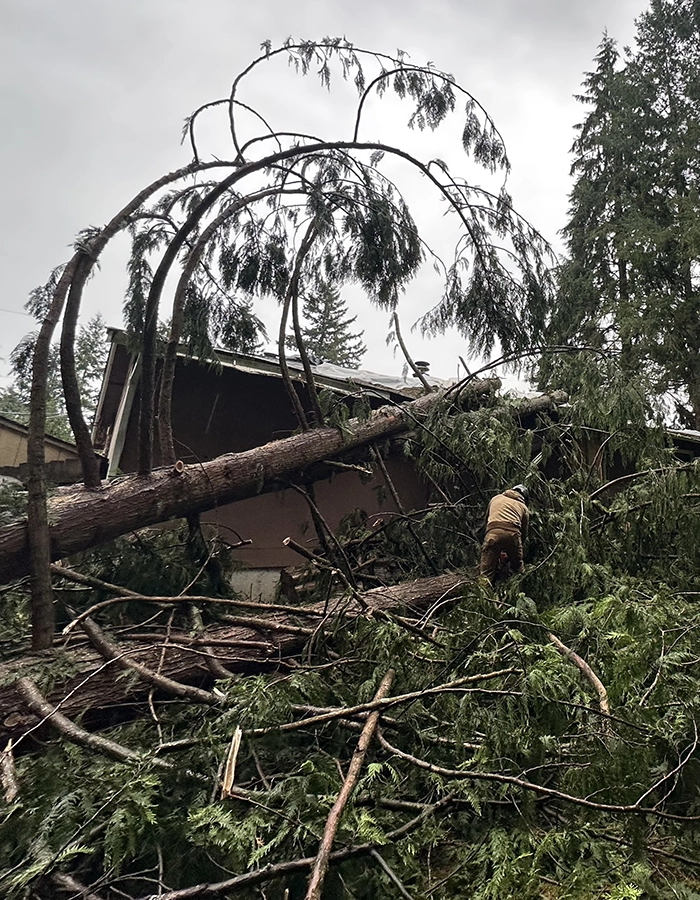
Many Snohomish properties sit on some of the most persistently saturated ground in the county. When a windstorm rolls through, those waterlogged soils give root systems almost nothing to hold on to. Douglas fir, Western red cedar, Cottonwood, and Hemlocks common across this area, can fail fast and fall hard.
Emergency Tree Services in Snohomish exist precisely because conditions here don’t give you much warning.
Acreage lots often have large conifers that have grown for decades with no real clearance from structures. After a storm, a leaning tree or a snapped top isn’t just an inconvenience. It’s an active hazard sitting over your roof, your driveway, or your power line. Waiting even a few hours can turn a manageable situation into a much more serious one.
Older established trees in urban areas present a different challenge. They don’t get the kind of attention rural lots do, and storm damage there can quickly affect neighboring properties.
If you’re looking at a fallen tree on your property right now, or something that shifted and doesn’t look right, that’s the moment to call. Fallen tree removal and storm-damaged tree assessment aren’t jobs that get easier with time. A qualified response now keeps the damage from compounding.
Ask Us About Emergency Tree Services
Why Family Ownership Changes Who Shows Up
Don’t Gamble on an Unknown Crew
Family ownership means something specific when a tree has come through your roof at midnight. When you call, you reach office staff or Brian directly. Not a call center routing your address to whoever is available in a three-county radius. Not a seasonal crew assembled last month.
The same family that started this business in 1988 is still in charge of the work.
Decades of emergency response in Snohomish County mean the people handling your hazardous tree removal have seen every variation of storm damage this region has to offer.
That experience is the difference between a qualified employee reading a compromised root plate correctly and someone guessing under pressure.
If you have a large conifer leaning toward your outbuilding and you need to know whether it’s coming down tonight or holding through the week. That assessment needs to come from someone with real field experience. Team members who have worked these properties for decades can give you a straight answer.
Because this is a family-run operation, there is no diffusion of responsibility. Brian knows what his employees are capable of. When emergency tree service goes out under the Chandler’s name, the accountability stays right there with the family that built it.
From Your First Call to Full Storm Damage Cleanup
Calling reaches the office staff or Brian directly. You explain what happened, where you are, and what you can see. If a large conifer came down overnight, that context shapes how quickly someone gets out to you and what they bring.
Brian personally handles the on-site estimate in the vast majority of cases. Occasionally, a climber goes instead, but this is never a handoff to a stranger with a clipboard. The person who shows up knows what they are looking at and can tell you exactly what needs to happen and why.
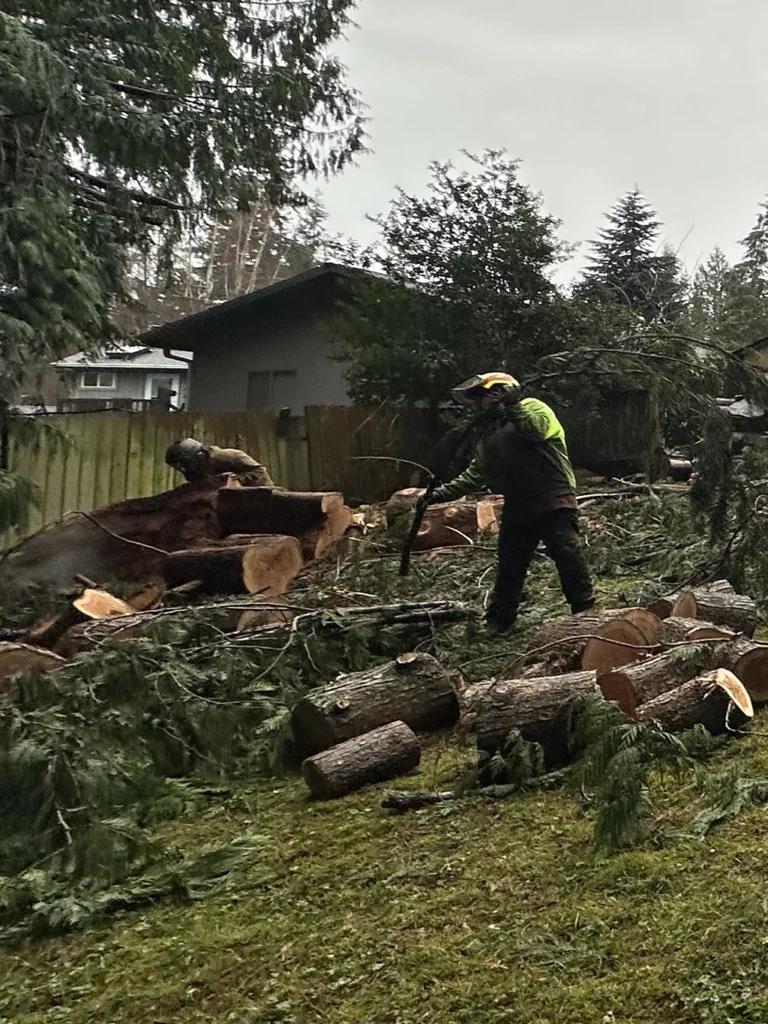
The tree assessment comes first. Before any removal starts, the immediate hazards are identified, and a safe working sequence is established. If a tree is still partially attached and leaning toward your structure, that determines where the work begins, not where it is easiest to start.
Fallen tree removal and emergency pruning of damaged limbs follow in order. Storm damage cleanup runs alongside the removal work, so debris does not pile up and create secondary hazards on your property.
If you want the job fully resolved, stump grinding can be quoted and scheduled as a follow-up. Stump grinding is handled separately and requires underground utility lines to be located and marked before any grinding can start, so it is typically scheduled about a week out rather than done the day of the removal.
You still get the immediate hazard cleared right away, with the stump handled cleanly once locating is complete.
The Hidden Indicators That Mean a Leaning Tree Needs Assessment Now
A Damaged Tree That Looks Stable Today Can Fail Without Warning Tomorrow
Assuming a tree is safe because it is still standing after a storm is one of the most common mistakes property owners make. A tree that survives a wind event upright can still have a partially lifted root plate, internal trunk decay, or a compromised union that ground-level observation simply won’t reveal. The storm didn’t leave it unharmed. It left it unstable.
Species like Douglas fir and big-leaf maple are particularly deceptive. Their canopy can appear intact while structural damage has already occurred at the point where the root system meets the soil. Where soils remain saturated for extended periods, root anchorage weakens faster than on drier ground. A tree that held through one storm may not hold through the next.
If you’ve noticed a lean that wasn’t there before, soil heaving around the base, or cracks in the bark near the trunk collar, those are indicators that warrant a professional tree assessment now, not later. Waiting extends the window for secondary failure, and secondary failures rarely give notice.
A proper assessment of storm-damaged trees gives you a clear answer: whether the tree can stay, needs emergency pruning, or requires hazardous tree removal before it becomes a larger problem. Risk management starts with knowing what you’re actually dealing with.
Tree Removal
Safe efficient removals
Tree Trimming
For beautiful, healthy trees
Hedge Trimming
Shaping of hedges and shrubs
Emergency Tree Services
Rapid response for emergencies
Storm Damage Prevention
Proactive protection before storms hit
Stump Grinding
Stump grinding for a usable landscape
Go From Crisis to Cleared Property With One Company
One Call Covers it All
You wake up, and a large tree is across your driveway. Your first questions are probably practical ones: do you call your insurance company first, do you need a permit to remove a tree that fell in a storm, and what happens to the stump?
Permit rules for tree removal vary by jurisdiction, and cities, counties, and other areas each have their own requirements. In many cases, a tree that poses an immediate safety hazard is treated differently, but the specifics depend on where your property sits. Calling is the fastest way to get a straight answer for your situation, and we can help you figure out what applies.
The estimate covers the full scope. Tree removal can be quoted alongside stump grinding, so you’re not chasing a separate contractor later. The stump itself is ground out as a scheduled follow-up once utility locating is complete, and Brian will account for access and root mass on-site rather than guessing over the phone.
If trimming is needed on adjacent damaged limbs, that gets folded into the same visit. You end up with the emergency cleared right away and a clear plan for anything left behind.