
Storm Damage Prevention In Snohomish
Protecting Snohomish Homes From Storm Damage Since 1988
Proudly serving Snohomish, Monroe, Marysville, Lake Stevens, Everett, and surrounding areas
How Local Conditions Turn Healthy-Looking Trees Into Storm Risks
Hazards That Build Quietly Before a Storm Arrives
The ground tells a story most people never read until a tree is already down. Storm Damage Prevention in Snohomish starts with understanding what the soil under your trees is actually doing. The glacial till and poorly drained valley soils throughout this area hold water long after a rain event ends, and a saturated root zone can lose its grip on even a structurally sound tree.
If your property sits out in the rural residential stretches beyond the city, prevailing wind patterns compound that problem fast. A tree that looks perfectly stable in dry conditions can become a genuine hazard when the ground beneath it is holding weeks of accumulated rainfall. That’s not a worst-case scenario. That’s a typical Pacific Northwest wet stretch.
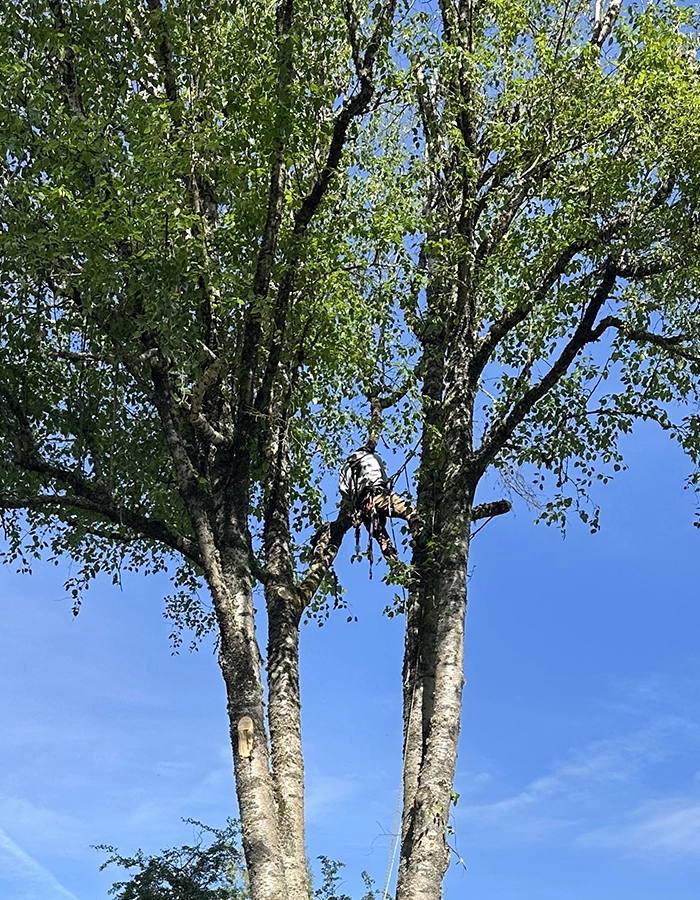
Ask Us About Storm Damage Prevention
Preventive Pruning Removes the Problem Before It Becomes an Emergency
Acting Before a Storm Is Simpler
Picture two neighbors on the same narrow street. One schedules a preventive pruning visit after noticing a heavy, overextended limb over their driveway. The other puts it off. The next windstorm settles the question for them.
The first path looks like this: a scheduled visit, controlled cuts, debris hauled away cleanly, and nothing damaged. The second path looks like emergency response at inconvenient hours, a fallen tree across a vehicle, debris removal that takes days, and a storm cleanup bill that dwarfs what preventive work would have cost.
If you have a tree with dead wood, crossing branches, or a canopy that’s grown heavy on one side, that’s not a cosmetic issue. That’s a liability waiting for the right wind event to activate it.
Preventive pruning gives you a concrete outcome: less weight on vulnerable limbs, better structure, and a tree that handles wind load without failing.
For structurally sound trees with weak or overextended limbs, cabling and bracing can provide support and reduce the risk of failure under load. Storm cleanup after the fact gives you none of that. It just restores what you had before, minus the tree.
Trees that split into two or three trunks low on the stem carry a hidden weak point where those trunks meet. Under the weight of wind, rain, or snow, that union can fail and bring down a large section of the tree. Cabling reinforces those trunks and takes pressure off the weak point, which can prevent a hazardous failure before storm season arrives.
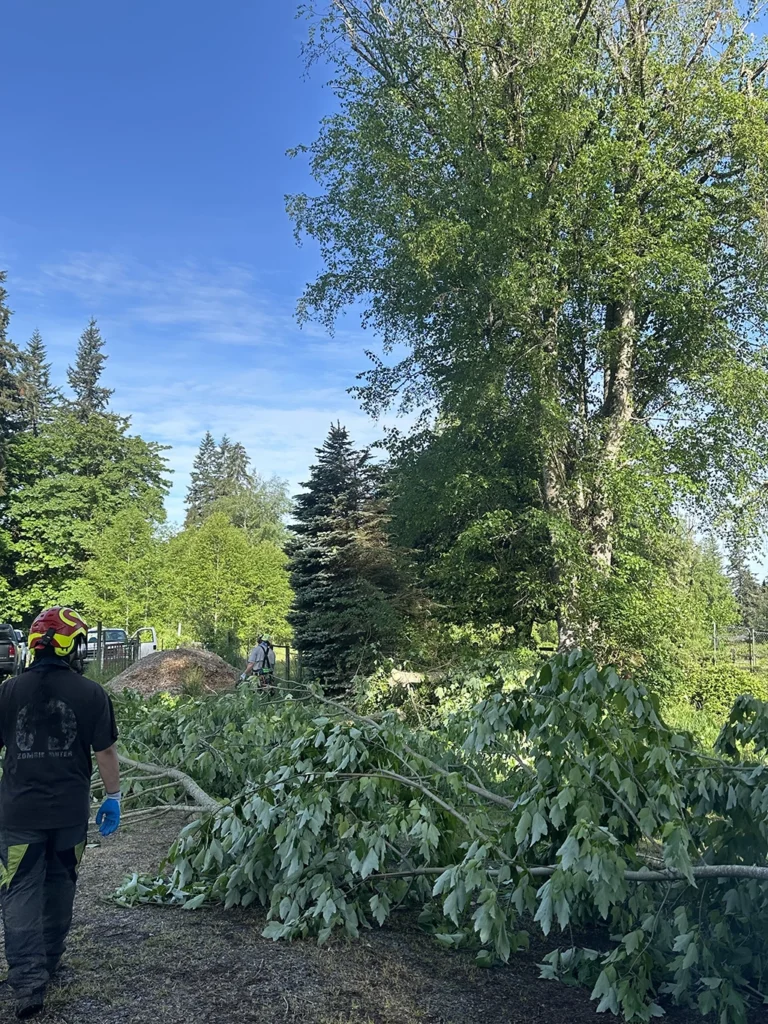
From Initial Assessment to a Clear Plan for Your Property
Calling to schedule starts with reaching the office staff or Brian directly. From there, Brian personally handles the estimate in almost every case, coming out to your property to walk the site with you. Occasionally, an expert climber goes in his place, but someone with real field knowledge is always making that call.
The storm damage assessment begins with a full walkthrough of your lot. Dead limbs, leaning trunks, cracked branch unions, root zones compromised by saturated ground, every concern gets looked at before any work starts.
If pruning or cabling is needed, it can be scheduled from there. We can also remove a tree that is too far gone to save. If you also want the stump handled afterward, stump grinding is available as a separate follow-up: it requires underground utility lines to be located and marked first, so it is typically scheduled about a week out rather than done the same day.
The work is handled by qualified employees who know how trees in this region behave under load. You get a straight assessment of what your property needs and a clear plan for addressing it.
Licensed, Bonded, and Insured, and Accountable to the Same Community Since 1988
Decades Serving Snohomish Homeowners
Decades in one community mean something specific: your neighbors have hired this company, and the reputation behind every storm damage project is tied directly to people who live and work in the same area you do. That kind of accountability shapes how the work gets done.
Being licensed, bonded, and insured isn’t just paperwork. If a hazardous tree on your property falls onto a neighbor’s vehicle or roof, your liability exposure is real. Hiring a company carrying proper insurance is one of the clearest ways to protect yourself before fallen trees become someone else’s problem.
Out in the surrounding agricultural corridors, mature conifers and large deciduous trees are common. Assessing storm risk in that kind of canopy takes consistent judgment, not a rotating cast of seasonal hires. Experienced employees bring context about how trees in this region actually behave under load.
Tree Removal
Safe efficient removals
Tree Trimming
For beautiful, healthy trees
Hedge Trimming
Shaping of hedges and shrubs
Emergency Tree Services
Rapid response for emergencies
Storm Damage Prevention
Proactive protection before storms hit
Stump Grinding
Stump grinding for a usable landscape
Why a Tree Worth Monitoring Now Deserves Attention Before It Becomes Urgent
Here Is What to Watch For
A homeowner notices a lean in one of their large conifers after a wind event last year. It seemed manageable, so they waited. By the following wet cycle, the lean had increased, and the removal became significantly more involved than it would have been earlier.
That pattern is common. Saturated soils gradually erode root anchoring over multiple rain cycles. Structural cracks widen. A tree that looks like a monitoring situation in one period can become a complicated removal in the next.
If you see a lean that wasn’t there before, bark splitting near the base, or soil heaving on one side of the root zone, those are signs worth discussing. Earlier action typically means simpler, more controlled work.
The earlier a storm risk gets identified, the more options you have: a targeted prune, cabling for support, or a planned removal handled on your schedule rather than the weather’s. Starting with a free estimate is the simplest way to find out where your trees stand.